Back to Exhibitions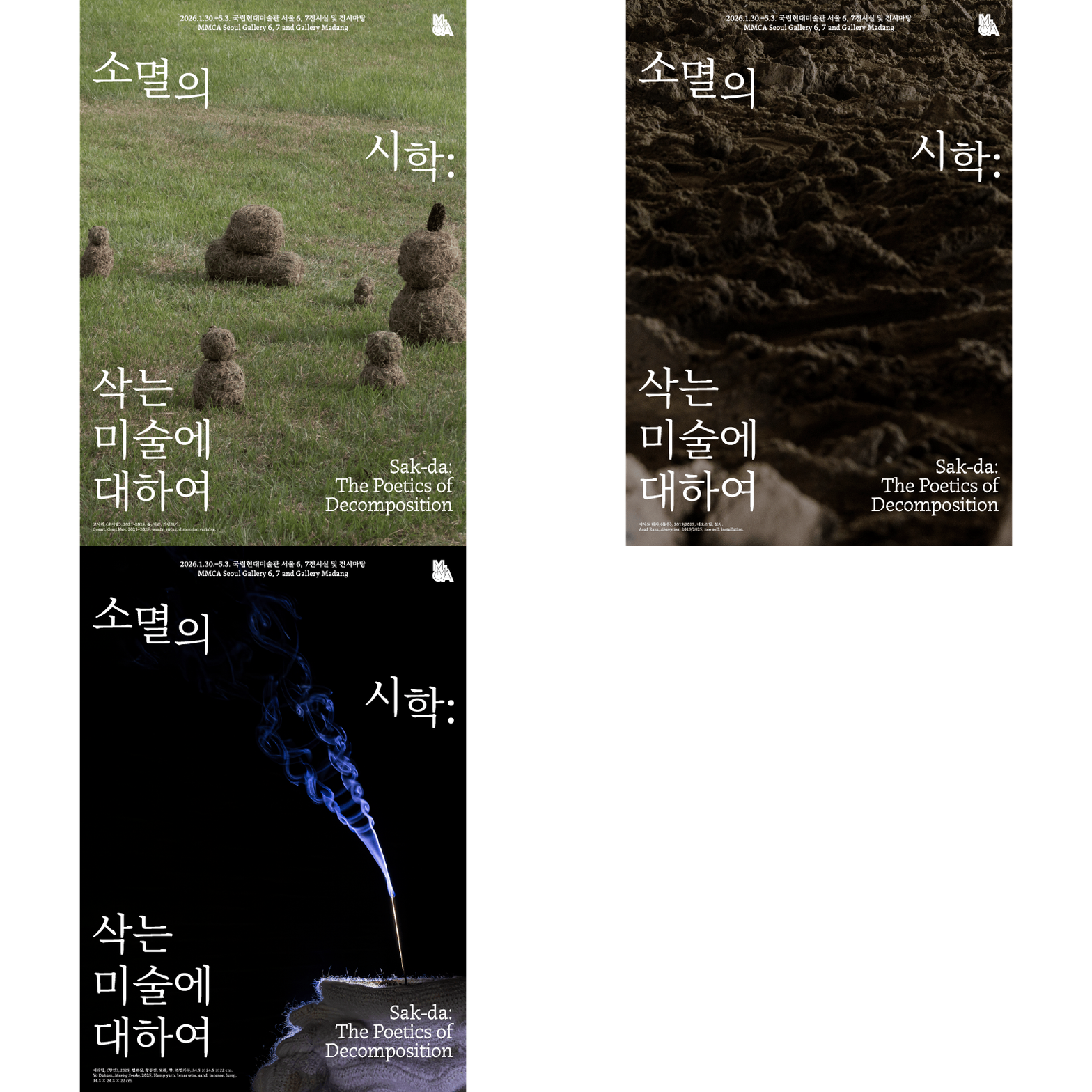
ExhibitionOngoing
Sak-da: The Poetics of Decomposition
소멸의 시학: 삭는 미술에 대하여
About
An outstanding work of art is often referred to as a 'timeless masterpiece.' Here, the term timeless carries a literal sense of 'not decaying.' If a great work of art is something that does not change, or must not change, then why do artists deliberately create works that inevitably change and disappear?
Sak-da: The Poetics of Decomposition introduces works that acknowledge a fate of eventual decay, works that intentionally leave nothing behind, and works that perform their own decomposition, brought together under the practice of 'Sak-da.' This approach arises from a desire to examine the changing nature of artworks amid contemporary critiques of anthropocentrism and the backlash against advanced capitalism and technocracy, and from a faint hope that wisdom for navigating the current crisis might emerge from such change.
The native Korean verb 'Sak-da' encompasses meanings such as 'to become rotten,' 'to lose vitality,' as well as 'to be digested' and 'to ferment and develop flavor.' This multiplicity of meanings offers a productive way to interpret the transformations of contemporary works. Beyond the negative connotations of decay, 'Sak-da' evokes both the descent and ascent of energy, as well as qualitative enhancement achieved in collaboration with nonhuman beings. What occurs when an 'artwork' decays as evidence of human creation? If plants grow, wind blows, and invisible life stirs in the place where the piece falls apart, can it still be called an 'artwork'? And if so, whose work is it?
Museums, as repositories of timeless masterpieces, have long devoted themselves to preserving the value of great works unchanged. The practice of Sak-da asks whether museums are prepared to embrace works that choose to decay in order to co-live with diverse beings beyond humans. In these uncertain times, can we acknowledge that the moment may call not for better conservation, but for better ways to decompose?