Back to Concerts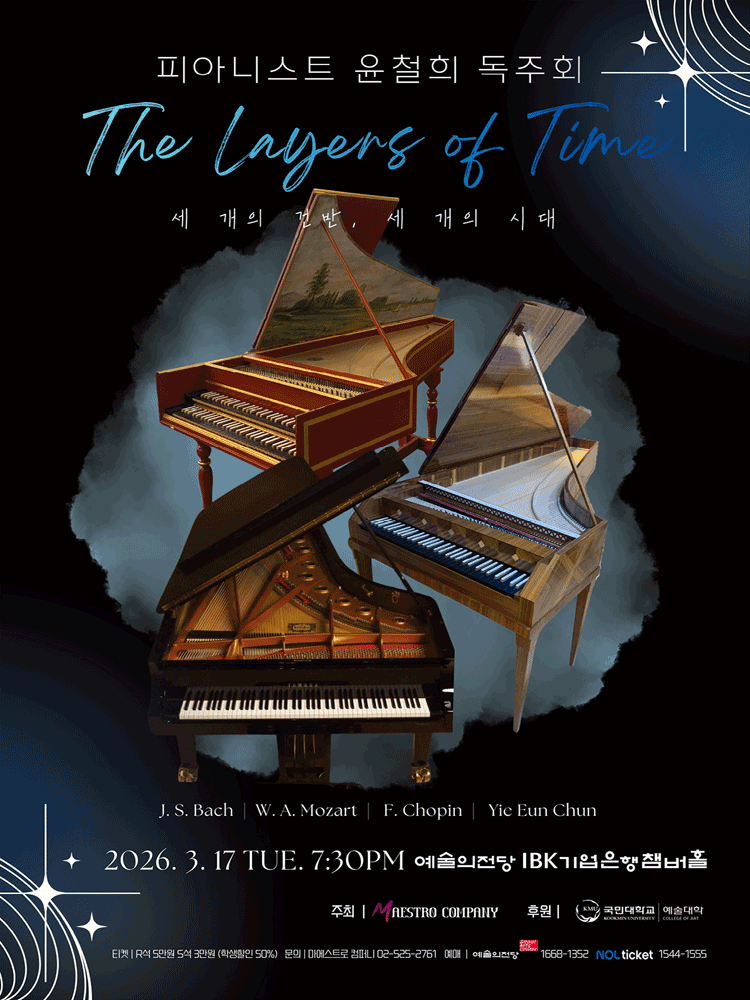
ConcertUpcoming
Pianist Yoon Chulhee Recital
피아니스트 윤철희 독주회
About
[Performance Introduction]
Three Instruments, Three Eras
Summoning 300 Years of Musical History to the Stage
Pianist Yoon Chul-hee's Historic First Attempt in Korea
While typical recitals confine themselves to performing a single era with a single instrument, pianist Yoon Chul-hee's stage fundamentally challenges this convention.
This performance places three keyboard instruments—harpsichord, fortepiano, and modern piano—on a single stage, allowing audiences to experience approximately 300 years of musical history spanning Bach–Mozart–Chopin through "the sound itself."
On this stage, it is not merely different pieces that are presented. The instrument itself changes, and how the language of music, its aesthetics, and the composer's way of thinking evolved in accordance with each instrument becomes vividly apparent.
From Harpsichord to Fortepiano, and to Modern Piano
Bach's music is performed on harpsichord. The 18th-century French Taskin-style harpsichord, with its brilliant yet delicate timbre, reveals the structural clarity and rhythmic vitality of Bach's music in its most authentic form.
Mozart's music follows on fortepiano. The Walter-style fortepiano, unlike the modern piano, possesses a transparent, light timbre and refined dynamics, maximizing the balance and elegance unique to Classical music. This becomes the most direct answer to the question: "Why was Mozart able to write such music?"
Finally, Chopin is performed on modern piano. The modern piano, with its expanded range, deepened resonance, and ability to express subtle emotional gradations, dramatically highlights the interiority and lyricism inherent in Romantic music.
"The Possibilities of the Fortepiano" Rewritten by Today's Composer
Another crucial element of this performance is a new work by composer Professor Jeon Ye-eun. This work does not merely aim to recreate past instruments. Through a contemporary composition specially written for fortepiano, Professor Jeon illuminates how the fortepiano differs from today's piano and what sensory resonance it possesses.
Through this, audiences encounter the fortepiano not as "an instrument of the past," but as a living sound language of our present age—a moment where past and present naturally converge on stage.
Experimental Yet Educational, and Above All, Fascinating
This performance is not a simple commissioned concert. It represents a remarkably rare undertaking in Korea, arguably the first of its kind. Having a single performer move between three instruments, performing music from each era on its respective instrument, demands tremendous preparation, research, and artistic commitment.
This is a stage that is experimental and simultaneously highly educational. For those of us living in the modern age where AI and digital technology are commonplace, this performance becomes a living music history lesson, revealing "how music has developed over 300 years through the hands, ears, and minds of humanity."
Yet above all, the greatest virtue of this performance lies in its fascination. Each time the instrument changes, the texture of the air transforms, and entirely different worlds unfold despite being the same keyboard instruments. Audiences naturally become attentive, experiencing not merely "listening" to music but "comparing and experiencing" it.
Pianist Yoon Chul-hee: A "Thinking Musician" Beyond Performance
Pianist Yoon Chul-hee is not simply a performer who plays pieces. He is a musician who deeply contemplates the relationships between instruments, eras, and composers, bringing to the stage the conditions and contexts in which music was born.
This performance is the culmination of years of research, performance experience, and sincere inquiry into music that Yoon Chul-hee has accumulated. Preparing three instruments for a single recital and establishing new performance techniques and interpretations suited to each instrument is by no means easy. Yet he chose this challenging path.
The reason is clear: he wanted to show audiences **'music as living history.'**
One Recital, Yet One Event
This stage is not simply a solo recital. It is an event, a question.
Why have we performed this music in this way,
and how should we listen to and understand music going forward?
Pianist Yoon Chul-hee's performance is a sincere and passionate response to that question.
[Program]
J.S. Bach / French Suite No.5 in G Major, BWV 816
W.A. Mozart / Piano Sonata No. 3 in B-flat Major, K. 281
W.A. Mozart / Duport Variations in D Major
F. Chopin / Nocturne in C Minor
F. Chopin / Waltz in A-flat Major, Op. 42
F. Chopin / Scherzo No. 3 in C sharp Minor, Op. 39
D. Scarlatti / Sonata K. 491
D. Scarlatti / Sonata K. 132
Yie Eun Chun / Touch